A couple called me on a Monday morning last month. Their DJ had ghosted five days before the wedding. Not sick — gone. Phone off, email dead, deposit non-refundable.
They'd asked all the wrong questions.
I've DJ'd over 2,000 weddings. I've sat across from thousands of couples during intake meetings. And I can tell you: most couples ask five questions when they should be asking twenty-seven.
"What's your price?" isn't the first question. Neither is "do you have our songs?" Those matter — but they're question 18 and question 22. Ask them too early and you'll miss the ones that actually decide whether your reception is unforgettable or a mess your MOH still brings up at brunch.
This is the list I wish every couple had before their first call with any DJ — mine or anyone else's. Twenty-seven questions across seven categories. Some are basic. Some are traps you didn't know were traps. And a handful are questions almost no couple asks because they don't know to.
If you can only ask five, ask the ones marked Must-ask.
The single most important question is: Will YOU personally be our DJ, and is your name in the contract? After that, ask about backup equipment, a named backup DJ, whether they MC as well as spin, how they handle guest requests, and exactly what's included in the price.
Watch red flags on insurance, deposits, and streaming platforms. The 27 questions below are broken into 7 categories — Basics, Experience, Music & Style, Equipment & Backup, MC & Timeline, Pricing & Contract, and Red Flags & 2026 Realities.
The Basics
Table stakes. Ask these on the first call. If any answer is fuzzy, keep looking.
1. Are you available on our wedding date?
Sounds obvious. Ask it first. If they say yes without checking a calendar, they're either disorganized or guessing — both are bad signs. A pro checks the calendar in front of you and either confirms with a soft hold or says no. Peak Saturdays book 12–18 months out.
2. Will YOU personally be our DJ — and will your name be in the contract? Must-ask
This is the question. Multi-op DJ agencies sell you the founder in the sales meeting and send a rookie in the truck on your wedding day. It's called bait-and-switch, and it's the number-one complaint against DJ companies industry-wide. Get the specific DJ's name written into the contract, plus a clause requiring your written consent for any substitution.
3. Can you provide a Certificate of Insurance?
Any working wedding vendor should carry at least $1M in liability. Most venues require the COI on file 30 days out. If your DJ can't produce one within 24 hours of your ask, they're not insured — and if a speaker knocks over grandma or their gear starts a fire, that liability lands on you.
Experience
There's a big difference between "a DJ" and "a wedding DJ." These questions reveal which one you're hiring.
4. How many weddings — specifically — have you done?
Not events. Not gigs. Weddings. A club DJ who does two weddings a year and a wedding DJ who does eighty are not the same person. Under 20 weddings, you're paying for their learning curve. 50–100 is solid. 200+ means they've seen almost every way a reception can go sideways and have a plan for each version.
5. Have you worked at our venue before?
Every venue has quirks. Some ballrooms have one floor outlet in a corner. Some historic sites cut you off at 10 PM if you don't know the curfew. Some venues won't let you rig to a wall. A DJ who's played your venue five times is worth $200 more than one who hasn't. Ask which venues they know and how well.
6. Can I see raw video from a real wedding — not just a highlight reel?
Highlight reels are edited. You want 30 unbroken seconds of them announcing a bridal party, or one clean shot of them mixing. If they only send montages set to hype music, something's off. Also check reviews on The Knot and WeddingWire — not just their own site. Their site shows the wins. The Knot shows the losses too.
7. Do you DJ weddings full-time — or is this a side hustle?
Nothing inherently wrong with a side-hustle DJ. But they're harder to reach when your planner needs a timeline revision on a Tuesday afternoon. Ask what their day job is if they have one, and whether they can leave work for your rehearsal without drama.
Music & Style
This is where couples over-index — "do you have our songs?" — and where the harder questions actually live.
8. How do you handle must-play and do-not-play lists?
The right answer: give me your top 5–10 must-plays and top 5–10 do-not-plays, and let me build the rest around what the crowd is doing. If a DJ wants you to submit 60 must-plays, they're not planning to read the room. They're planning to hit play on your Spotify wedding playlist while they scroll their phone.
9. Do you download tracks or stream them from Spotify? Must-ask
Two problems with streaming. First: reception venue WiFi is unreliable, and if it drops mid-first-dance, your first dance stops. Second: playing a personal Spotify account at a paid public event violates Spotify's Terms of Service. Working DJs pull from licensed DJ pools — Promo Only, BPM Supreme, DJ City — and store files locally on their laptop.
10. What's your policy on guest requests?
The answer should be nuanced. A blanket "yes to everything" means they'll play Baby Shark if your cousin's kid asks. A blanket "no requests" means they can't recover if the vibe shifts. The right answer: "I take requests that fit the room and don't violate your do-not-play list."
11. Do you offer live musicians alongside the DJ set?
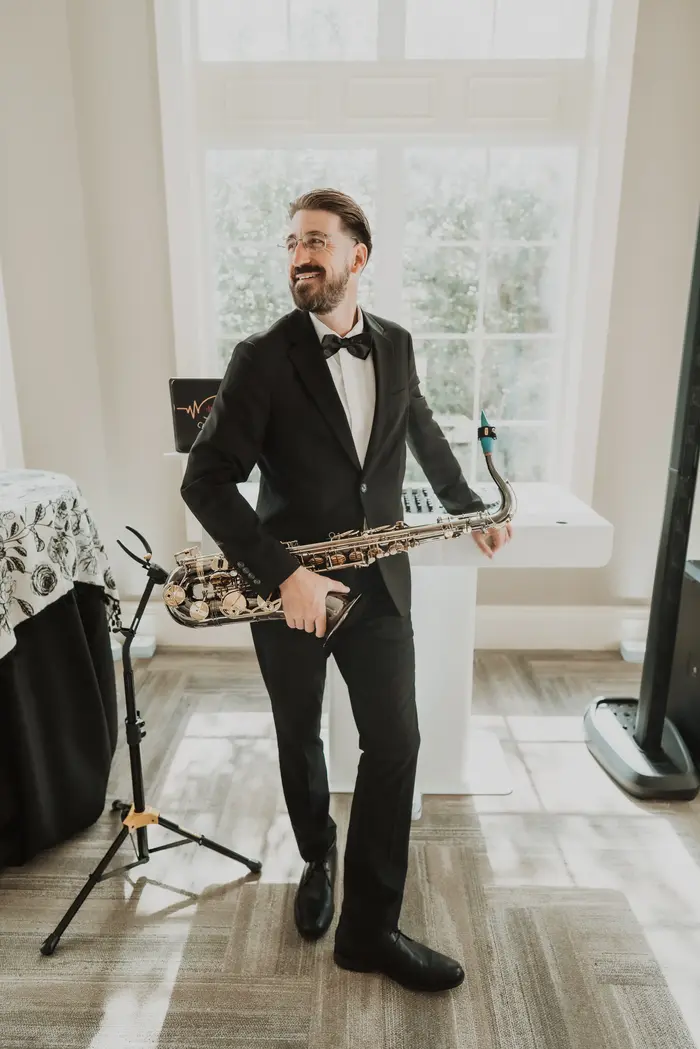
The hybrid setup — sax over cocktail hour, percussion joining in on select dance tracks, violin for the ceremony processional. Not for every wedding, but it changes the room when it works. Ask whether the musicians are the DJ's own team or subbed out. Subbed-out musicians who've never played with the DJ can miss cues. Same-team musicians rehearse together.
12. Are you comfortable with our cultural, religious, or LGBTQ+ music needs?
Persian doholla, Jewish hora, South Asian baraat, K-pop mini-sets, Latin cumbia, gender-neutral announcements — these aren't extras. They're the moments guests remember. A DJ who says "yeah, no problem" without asking follow-ups is guessing. A DJ who asks what specifically has done it before.
Equipment & Backup
Equipment fails. Not usually — but often enough that any pro has a plan for every failure mode.
13. What equipment do you bring — and what backups?
Baseline: two full-range speakers, a subwoofer for dance floors over 100 guests, two microphones (one wired for backup, one wireless for toasts), and a laptop with all music stored locally. Backup should mean a second laptop, spare mic, and small backup speaker in the truck. Not "I could rent one if needed."
14. What happens if your laptop crashes mid-reception?
The right answer: instant switch to the backup laptop, then troubleshoot on the second unit during dinner. If they hesitate on this question, they don't have a backup. Ask them to walk you through the exact next 90 seconds after the music stops.
15. What's your plan if YOU personally can't make it? Must-ask
Illness, family emergency, car accident — it happens. The answer you want is a specific person by name, ideally someone you can meet before the wedding, with a written contract clause confirming the backup DJ has comparable skill and honors the same pricing. "I'd find someone" is not an answer. "Kyle steps in — you've met her, she's here in this consultation" is.
16. Do you bring a wireless mic for toasts?
Yes is the only right answer. Handheld wireless with a fresh battery, not the DJ's headset mic passed around. Ideally two wireless mics so a maid of honor and best man don't have to trade off mid-toast. If they say "we'll figure it out on the day" — keep looking.
MC & Timeline
The DJ is only half the job. The MC is the other half — and most couples don't know to ask about it separately.
17. Do you MC too — and what's your announcing style?
DJ and MC are different skills. Some DJs are excellent behind the decks but freeze on the mic. Ask specifically who announces bridal party entrance, cake cutting, bouquet toss, first dance, and last dance. If they subcontract MC work, that's another vendor to manage.
18. Can you give me a sample announcement right now?
Weird question. Ask it anyway. If they can't confidently announce your wedding party entrance on the spot during a phone call, they can't confidently do it in front of 150 guests. It doesn't need to be polished. It needs to sound natural, clear, and warm.
19. How do you build the reception timeline with our planner and photographer?
This is where receptions actually run smoothly or fall apart. If your DJ says "we'll follow the planner's timeline" without ever collaborating on it, they don't understand their role. The right answer sounds like: "I do a call with your planner and photographer two weeks out to align on cues, transitions, and lighting."
20. Tell me about a dance floor that died — and how you fixed it.
Every wedding DJ has a story. If they claim no dance floor has ever died on them, they're either lying or newly hired. What you want is a real 30-second story: what happened, what they read from the crowd, what they changed, what worked. You can't fake this answer.

Money questions belong at the end of the interview, not the start. Once you know they're a fit, then talk price.
21. What's included — and what triggers extra charges?
Every package has a fence around it. Ask what's inside: hours of coverage, ceremony sound, uplighting, wireless mics, MC service, travel, setup and breakdown. Then ask what triggers extra: overtime past a set end time, hours added the day of, travel outside a radius, gear you didn't book.
22. What's your deposit and cancellation policy?
Standard is 25–50% deposit to hold the date. Anything asking 100% upfront is a red flag. Cancellation policies should have a clear structure — usually the deposit is non-refundable, and cancellations within 30–60 days may forfeit more. Read the actual language. If you can't understand the cancellation clause, ask for a plain-English rewrite before signing.
23. Do you play more than one wedding per day?
The right answer is almost always no. A wedding DJ who's played a brunch wedding at 11 AM and needs to be at yours by 4 PM is not fully present. If they do, ask about buffer time, setup, and what happens if the first event runs long.
24. Is everything in a written contract with your name on it?
Not just the company name. The DJ's name. And the venue. And the date. And the specific package. And the payment schedule. And the cancellation terms. And a clause about substitutions. If any of those are missing, hand-write them in and initial before signing.
Red Flags & 2026 Realities
The last three reveal judgment. They tell you how the DJ thinks — not just what they do.
25. What would make you turn us down as clients?
Any DJ who says "we take every wedding" is lying or desperate. A good DJ has a filter. Maybe it's couples who won't share a preliminary timeline. Maybe it's weddings at venues they know are logistically impossible to serve well. Whatever their answer, it should sound thought-out — not defensive.
26. How do you handle a drunk guest who won't stop requesting songs on the do-not-play list?
Real scenario at almost every wedding. The right answer involves polite deflection, occasionally letting a low-stakes request through to keep peace, and never — ever — playing a song on your do-not-play list because a guest asked. If they say "the customer is always right," that includes the customer who's ruining your dance floor.
27. How do you work with noise curfews or historic-district restrictions?
St. Augustine's historic district. Beach venues in Ponte Vedra with 10 PM cutoffs. Outdoor venues with municipal ordinances. A DJ who's worked your venue should already know the curfew. Silent-disco setups — headphones for guests, no external speakers — are increasingly used to keep the party going past curfew.
The Questions Almost Nobody Asks (But Should)
These three round out the twenty-seven. They're the ones I wish couples asked me every intake meeting — because the answers reveal a DJ's craft in ways the standard checklist can't.
"What will YOU be asking us during intake?"
A pro DJ has a diagnostic intake — song list preferences, cultural specifics, family dynamics, do-not-mention topics, exit song, first-dance overlaps with photographer cues. If they don't have questions for you, they don't know what they're doing.
"How do you keep a sober-couple wedding energized on the dance floor?"
Alcohol-free and reduced-alcohol receptions are more common than they've ever been. The music strategy is different — more BPM management, more crowd cues, less reliance on drink-fueled energy spikes. Ask specifically.
"Do you sort your library by BPM to smooth out transitions?"
Insider question. A yes tells you they're mixing, not stringing playlist tracks together. A no — or "what's BPM?" — tells you what you needed to know.